Signet rings: heraldry you can wear
Once a working tool for sealing letters, the signet ring is now a quiet emblem of family and identity. How it works, what to engrave and on which finger it goes.
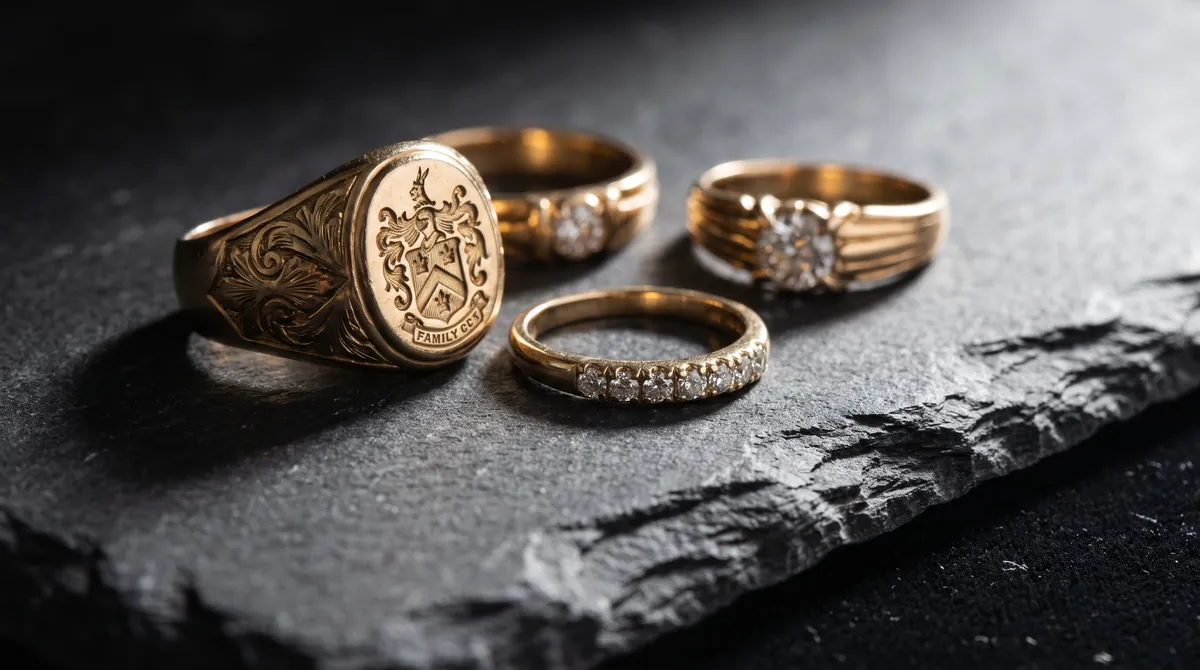

A signet ring looks simple: a band of gold with a flat face, often engraved with a or initials. Yet it is one of the few pieces of jewellery that began as a working tool. For centuries it was a means of proving identity, and the way it is made still reflects that original purpose. Understanding the signet ring means understanding seals, heraldry and a highly specialised form of engraving.
A seal on your finger
Before signatures and printed letterheads, a document was authenticated with a seal. Warm wax was dropped onto the paper or onto the fold of a letter, and the owner pressed an engraved surface into it. The impression showed who had sent or approved the document, and a broken seal showed that a letter had been opened. Kings, officials, merchants and private families all relied on seals, and the right to use a particular seal was carefully guarded.
The signet ring put that engraved surface on the hand, where it was always available and difficult to steal. Because the owner wore it, the ring itself became a mark of authority and trust. Many signet rings today are never pressed into wax at all, but the design still follows the logic of the seal.
That logic explains the most important technical detail. The engraving on a traditional signet is cut in reverse, as an , sunk into the surface rather than raised above it. When the ring is pressed into wax, the impression comes out the right way round, with the design standing up in relief and any lettering reading correctly.
Because the owner wore it, the ring itself became a mark of authority and trust.
What to engrave: arms, crest or monogram
The traditional choice is heraldic. A full shows the shield together with the elements around it, such as the helmet, the mantling and the crest. On a small ring face that is a great deal of detail, so many families choose the crest alone.
The crest is easily confused with the whole coat of arms, but it is only one part of it: the device that sits above the helmet. Because it is compact, it fits neatly on a ring, and it was the element most often used on personal seals and silver.
In England, arms are granted to an individual by the College of Arms and pass to descendants by inheritance. They do not belong to everyone who shares a surname, so it is worth checking the right to use a particular crest before having it engraved. If your family has no arms, a monogram or initials are an entirely traditional alternative and can be just as handsome.
Heraldic engravers also have a clever way of showing colour in a single metal. A system of lines and dots stands in for the heraldic tinctures: vertical lines for red, horizontal lines for blue, dots for gold and a plain surface for silver. On a well cut seal you can read the colours of the arms without a trace of enamel.
Shapes, metals and stones
Signet rings come in a few classic forms. The oval is the most traditional and suits a vertical design such as a crest. The cushion, a square with softened corners, gives more room for a monogram, and the round face suits symmetrical designs. Whichever you choose, the size of the face should suit the hand: a broad face can look heavy on a slender finger, while a small oval can almost disappear on a large hand.
Most signets are made of gold, but the face does not have to be metal. Hardstones such as , sardonyx or lapis lazuli can be engraved instead, giving a band of colour on the hand. Engraved stones have a long history as seals: in the ancient world, carved gems were pressed into wax and clay long before the signet ring took its modern form, and a stone signet continues that lineage.
The craft of the engraver
Hand engraving is a specialist craft, and seal engraving is a discipline within it. A surface engraving, such as initials on the back of a watch, is cut shallowly and meant to be read directly. Seal engraving is deep intaglio work, cut in reverse, with carefully judged depths so that the impression in wax has real modelling and crisp edges.
Because the design must be planned in mirror image, the engraver works with great precision, often checking progress with trial impressions. A good seal engraving rewards close inspection: the crest has depth, the lines of the tinctures are even and the lettering is sharp. It is worth asking to see impressions of an engraver’s earlier work before you commission a ring.
How a signet ring is worn
In the British tradition the signet ring is usually worn on the little finger of the non-dominant hand, typically the left. That keeps it out of the way of daily tasks and leaves the dominant hand free, which made sense when the ring was a tool to be taken off and pressed into wax.
Beyond that, conventions vary between families and countries, and you will see signets on other fingers too. What matters most is a comfortable fit. A signet is a ring worn every day for decades, often passed down afterwards, so it should be heavy enough to keep its shape and sized to stay put without pinching.
Glossary
- Intaglio
- An engraving cut into a surface rather than raised from it, used for seals so the impression appears in relief.
- Crest
- The part of a coat of arms that sits above the helmet, often used alone on signet rings.
- Coat of arms
- A heraldic design granted to an individual, comprising the shield and the elements displayed around it.
- Carnelian
- An orange to red variety of chalcedony, traditionally engraved for seals and signet rings.
Questions readers ask
Can I have a signet ring without a coat of arms?
Yes. A monogram or initials are a completely traditional choice and suit any family. Heraldic arms belong to particular individuals and pass by inheritance, so they should only be engraved if you are entitled to use them. A well designed monogram, cut as a deep seal engraving, looks just as good on the hand and in wax.
What is the difference between seal engraving and surface engraving?
Surface engraving is cut shallowly and read directly, for example initials on the back of a watch. Seal engraving is deep intaglio work cut in reverse, so that when it is pressed into wax it produces a raised impression that reads correctly. It requires a different technique and is a specialist skill within hand engraving.
Which stones can be used for a signet ring?
Besides a solid metal face, hardstones are a traditional choice. Carnelian, sardonyx and lapis lazuli can all be engraved as seals, giving a ring of colour while keeping the function of the signet. Engraved stones were used as seals long before the modern signet ring, so a stone face continues a very old tradition of carved gems.