The tiara, explained
From the wreaths of antiquity to Napoleon’s court and modern royal weddings: where the tiara came from, the styles to know and the rules that still apply.
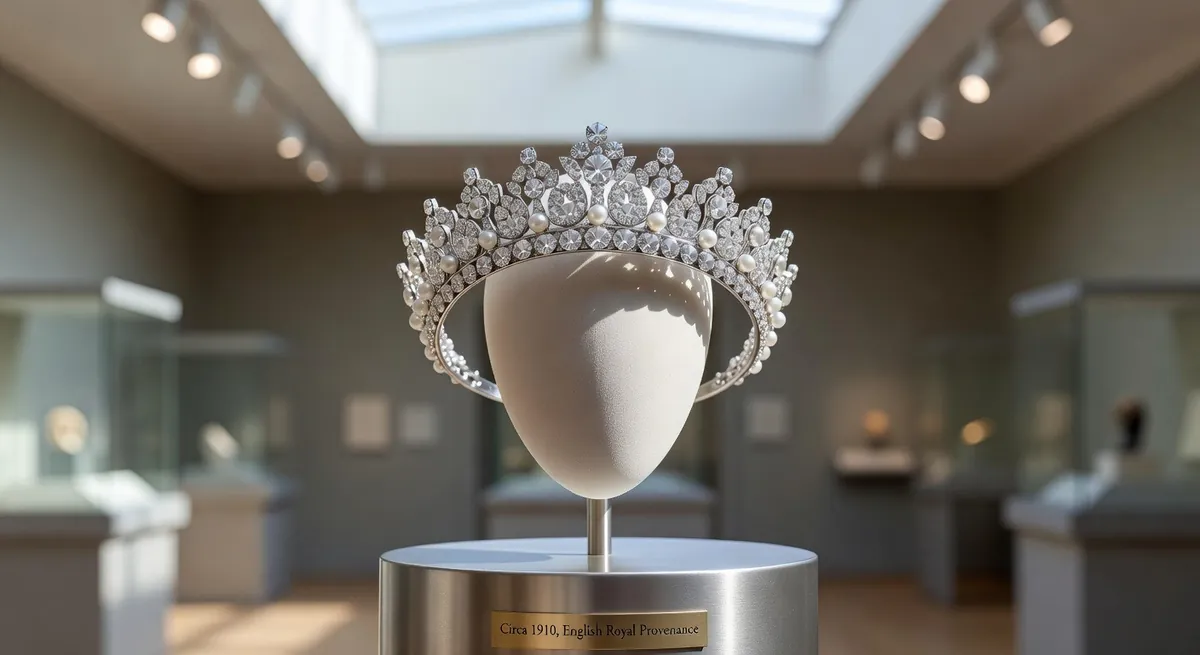

Few objects say “royal” as clearly as a tiara. It is a jewel worn on the head, yet it is not a crown, and the difference matters. A crown is a symbol of sovereignty. A tiara is an ornament, worn by queens and princesses but also, on the right occasion, by women with no title at all. Here is how it came about, the styles worth recognising and the etiquette that still decides when one appears.
From laurel wreath to court jewel
The idea of decorating the head is very old. In ancient Greece and Rome, diadems and wreaths of leaves marked out victors, rulers and those taking part in ceremonies. Many later tiaras still echo that origin, with leaves or sprays rising from a band that follows the curve of the head.
The tiara as we know it, a jewel of precious metal and stones, became a fixture of European court dress in the early 19th century. Napoleon’s court played a large part. The new emperor wanted a court with the splendour of the old monarchies, and the Empress Joséphine wore tiaras in the classical taste that suited the imperial style. Other European courts followed, and the tiara settled into its role as the most formal jewel a woman could wear.
Over the following decades the tiara became a standard part of a royal or aristocratic jewel collection. It was the piece that announced a grand occasion, and it was usually commissioned to last for generations rather than for a single season.
The styles worth recognising
Tiaras come in many forms, but a handful of shapes cover most of what you will see in portraits and photographs. Once you know them, you can name almost any tiara at a glance.
- : a narrow band worn low across the forehead. It was especially popular in the 1920s.
- Fringe: rows of graduated vertical spikes, rising towards the centre like a fringe of light around the head.
- : a solid halo shape inspired by the traditional Russian headdress of the same name.
- Circlet: a simple band that encircles the head, the form closest to the ancient .
- Convertible: a tiara that comes apart, so that its elements can be worn as brooches or the whole piece as a necklace.
Convertible tiaras deserve a special mention. A jewel worn only on a few evenings a year is a great deal of value to leave in a box, so jewellers designed frames from which the decorative parts could be removed and worn in other ways. The same diamonds could then serve their owner at a dinner, a ball or a daytime event.
The bandeau tells a different story. Worn low and straight across the brow, it belonged to the fashions of the 1920s and looks quite unlike the upright fringe or the solid kokoshnik. If you see a tiara worn in that position, you are almost certainly looking at a bandeau.
Who wears a tiara, and when
In the British tradition the rules are clear. A tiara is worn for evening events, the most formal dress code there is, which today usually means state banquets and a few very grand dinners and balls. It is an evening jewel, and traditionally it belongs to white tie rather than to less formal dress codes.
Tradition also says that a tiara is worn by married women. In effect, a tiara announced that its wearer was married. The exception is the bride: on her wedding day she may wear one, which is why so many famous tiaras are first remembered from wedding photographs.
A crown is a symbol of sovereignty. A tiara is an ornament.
One tiara, two royal weddings
The Queen Mary shows how a royal jewel carries meaning across generations. Princess Elizabeth, the future Queen Elizabeth II, wore it on her wedding day in 1947. In 2020 her granddaughter, Princess Beatrice, wore the same tiara at her own wedding.
That continuity is typical of royal jewels. Tiaras are rarely made for one occasion and then forgotten. They are kept, lent and worn again, and each appearance adds a chapter to their story. For the public, recognising a tiara at a wedding is part of the pleasure, because it links one generation of photographs with the next.
How a tiara is worn
A tiara is not perched on the very front of the head. It sits on the crown, set slightly back from the hairline, so that it frames the face rather than resting on the forehead. The bandeau is the exception, since it was designed to be worn low.
Keeping it in place is a small piece of engineering. Most tiaras are anchored with combs, or with little loops on the frame through which hair pins are passed. The hair needs to give the tiara something secure to hold, so the hairstyle and the jewel are best planned together.
Reading a tiara
Tiaras are worn less often than a century ago, simply because white tie evenings are rarer. Yet they remain a living tradition. They appear at state banquets and royal weddings, and they fascinate collectors and historians, because each one records a moment in the history of a family and of jewellery design.
If you want to read a tiara well, start with three questions. What is its shape: bandeau, fringe, kokoshnik or circlet? Was it made to come apart into other jewels? And where has it been worn before? The answers usually tell you much of its story.
Glossary
- Diadem
- An ornamental band worn on the head in antiquity, one of the ancestors of the modern tiara.
- Bandeau
- A narrow tiara worn low across the forehead, especially popular in the 1920s.
- Fringe tiara
- A tiara made of rows of graduated vertical spikes.
- Kokoshnik
- A tiara with a solid halo shape, inspired by the traditional Russian headdress.
- White tie
- The most formal evening dress code and the traditional occasion for wearing a tiara.
Questions readers ask
Can an unmarried woman wear a tiara?
In the British tradition tiaras are worn by married women, with one important exception: a bride may wear a tiara on her wedding day. Outside royal and aristocratic circles the convention is applied less strictly than it once was, but at formal occasions where tradition matters it is still widely respected and worth keeping in mind.
What is the difference between a tiara and a crown?
A crown is a symbol of royal authority, worn by a monarch or a consort, above all at a coronation. A tiara is an ornament rather than a mark of rank. By tradition it can be worn by any married woman at a white tie evening event, which is why tiaras are found in aristocratic families as well as royal ones.
How is a tiara kept in place?
A tiara sits on the crown of the head, set slightly back from the hairline. It is anchored with combs, or with hair pins passed through small loops on its frame. Because a tiara can be worn for many hours, it is worth practising with a hairdresser beforehand and checking that it stays secure when you move.