Complications decoded, from moon phase to minute repeater
Calendars, moon phases, chronographs, tourbillons and repeaters: what each watch complication actually does, and why collectors value them so highly.

Watch collectors talk about complications constantly, and the word can sound more mysterious than it is. In watchmaking, a is any function of a mechanical watch beyond showing the hours, minutes and seconds. A simple date window is a complication. So is a mechanism that chimes the time on tiny gongs. Between those two lies a world of ingenuity, and this guide takes you through the main families one by one.
Calendars: from the date window to the perpetual
The most common complication is the date, shown through a small window or by a hand pointing to a scale. A day-date adds the day of the week. Both are useful, but a simple date has no idea how long each month is: at the end of a 30 day month, and at the end of February, you have to move it on by hand.
An annual calendar solves most of that problem. It knows the difference between months of 30 and 31 days and needs correcting only once a year, at the end of February. A goes further. It accounts for the different lengths of the months and for leap years, so it shows the correct date without any adjustment for decades.
Even a perpetual calendar has a limit, and it comes from the calendar itself. Under the Gregorian rules, a year divisible by 100 is not a leap year unless it is also divisible by 400. The year 2000 was a leap year, but 2100 will not be. Most perpetual calendars are built on the four year cycle, so they will need a correction in 2100, when the leap year is skipped.
The sky on your wrist: moon phases
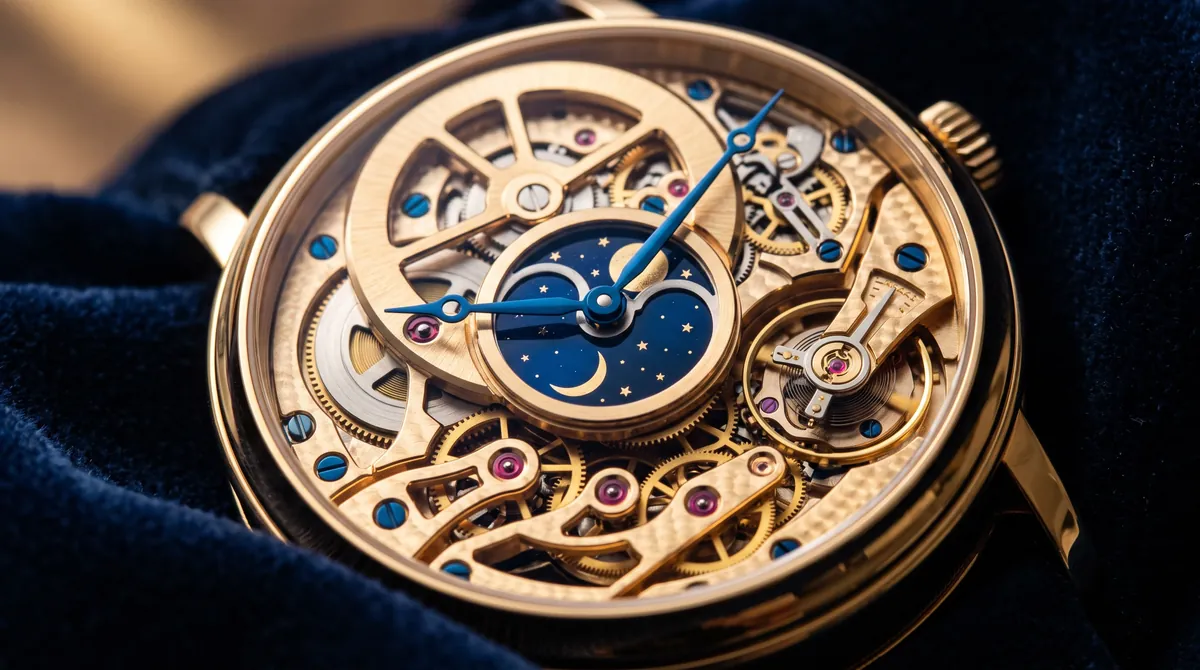
A moon phase display shows the lunar cycle, the period of about 29.5 days from one new moon to the next. Usually a disc painted with two moons turns slowly beneath a curved opening in the dial, so that the moon appears to wax and wane.
Few people need to know the phase of the moon in daily life, which is part of the charm. The display connects a modern watch with the astronomical clocks of earlier centuries, when the moon mattered for travel at night, for tides and for the calendar of religious festivals. It is also one of the most decorative complications, often combined with a calendar.
Measuring time and crossing time zones
A chronograph is a stopwatch built into a watch. Pushers on the side of the case start, stop and reset a separate seconds hand, while small sub-dials count the elapsed minutes and often the hours. It is the complication most associated with motor racing and aviation, and among the most complex to build well.
A GMT or dual time watch shows a second time zone. This is often done with an extra hand that goes round the dial once in 24 hours, pointing to a separate scale. For anyone who travels or works with colleagues abroad, it is one of the most practical complications of all.
The tourbillon: a cage against gravity
The is the complication with the grandest reputation. It was invented by Abraham-Louis Breguet and patented in Paris in 1801. Breguet’s problem was the pocket watch, which spent most of its life standing upright in a waistcoat pocket. In that position, gravity pulls constantly on the balance and the parts that regulate the watch, causing small errors.
His answer was to place the , the heart of the timekeeping, inside a rotating cage. As the cage turns, often once a minute, the errors caused by gravity in each position are averaged out. On a wristwatch, which changes position all day, the practical benefit is debated. What remains is a beautiful demonstration of skill, usually displayed through an opening in the dial so you can watch the cage turn.
A complication is any function of a mechanical watch beyond showing the hours, minutes and seconds.
The minute repeater: time you can hear
The is often described as the most demanding complication of all. On demand, usually when you move a slide on the side of the case, it chimes the time using small hammers that strike gongs coiled around the movement. Originally it served a very practical purpose: telling the time in the dark, before electric light.
The sequence follows a simple logic. A low tone counts the hours, a pair of high and low tones counts the quarter hours, and a high tone counts the minutes past the last quarter. At 10.49, for example, you would hear ten low tones, three double tones and four high ones.
Complications can also be combined. A watch that brings several of them together in one movement, for instance a perpetual calendar, a chronograph and a repeater, is often called a grand complication. Fitting so many functions into a single case, and making them work together reliably, is among the hardest tasks in watchmaking.
Why do collectors care so much? Partly because complications are difficult. Each one adds parts, adjustment and hand finishing, and the most complex need specialists who have spent years mastering a single mechanism. Partly, too, because they carry history: the perpetual calendar, the tourbillon and the repeater are mechanical solutions to real problems, kept alive as a craft long after technology moved on.
Glossary
- Complication
- Any function of a mechanical watch beyond showing hours, minutes and seconds.
- Perpetual calendar
- A calendar mechanism that accounts for month lengths and leap years, needing no correction until 2100.
- Escapement
- The part of a movement that releases the energy of the mainspring in small, regular steps.
- Tourbillon
- A rotating cage carrying the escapement, invented by Abraham-Louis Breguet to average out the effects of gravity.
- Minute repeater
- A striking mechanism that chimes the hours, quarter hours and minutes on demand.
Questions readers ask
What is the difference between an annual and a perpetual calendar?
An annual calendar knows which months have 30 and which have 31 days, but it does not understand February, so it needs correcting once a year at the end of that month. A perpetual calendar also accounts for February and for leap years. It needs no correction until 2100, when the Gregorian calendar skips a leap year.
Does a tourbillon make a wristwatch more accurate?
The tourbillon was designed for pocket watches, which spent long periods upright, and it averages out the effect of gravity on the escapement by rotating it in a cage. A wristwatch changes position constantly through the day, so the practical benefit is debated. Collectors value the tourbillon mainly as a demonstration of watchmaking skill and history.
How does a minute repeater tell the time?
When activated, usually with a slide on the side of the case, small hammers strike gongs inside the watch. Low tones count the hours, paired tones count the quarter hours and high tones count the remaining minutes. It was originally a way of telling the time in the dark.