The Cullinan: the story of the largest gem diamond ever found
Found in South Africa in 1905, given to Edward VII in 1907 and cut in Amsterdam in 1908: how the largest gem diamond ever found became part of the Crown Jewels.
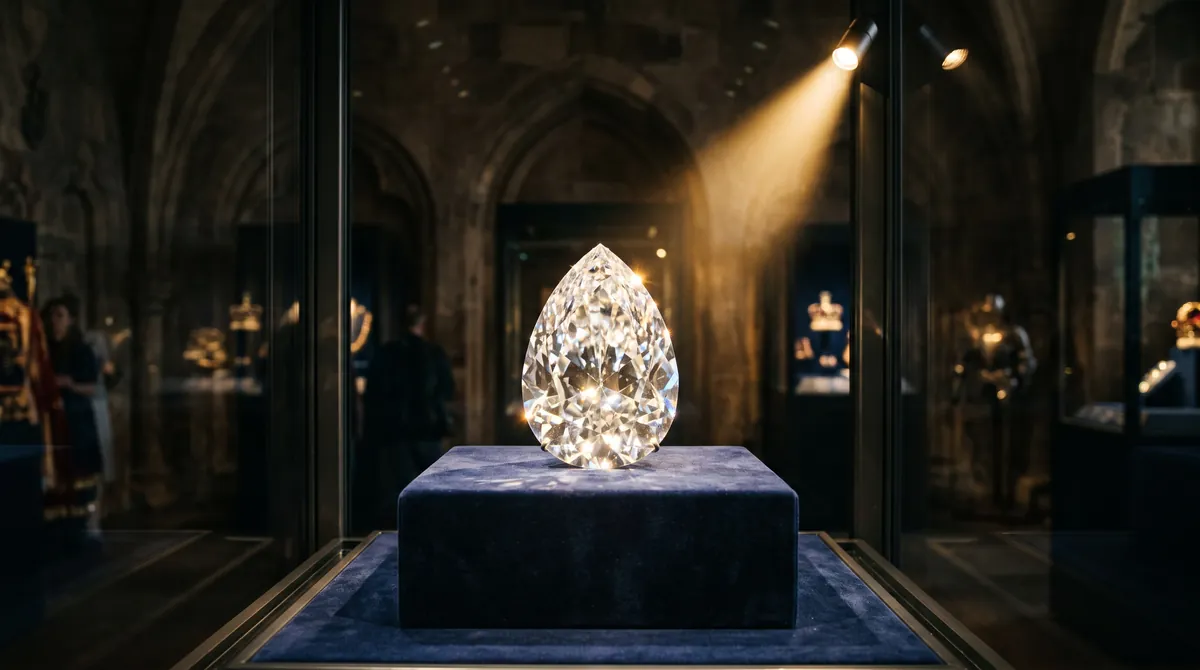

Some gemstones are famous for their beauty, others for their history. The Cullinan is famous for both, and for its sheer scale. It is the largest gem diamond ever found, and the stones cut from it now sit at the heart of the British Crown Jewels. Its story runs from a South African mine to a royal birthday, a cutting workshop in Amsterdam and, finally, the Tower of London.
A discovery near Pretoria
The Cullinan diamond was found on 26 January 1905 at the Premier Mine near Pretoria, in South Africa. In the it weighed 3,106 carats. Since one carat is 0.2 grams, that is more than 600 grams, well over half a kilogram of diamond in a single crystal.
The stone was named after Thomas Cullinan, the owner of the mine. By then South Africa had become the most important source of diamonds in the world, following the discoveries around Kimberley in the previous century, but nothing of this size had been found before. The stone immediately raised a practical question: who could possibly own such an object, and what should be done with it?
A rough diamond of that size is not a finished jewel. It is a raw crystal, valuable above all for what might be cut from it. Its future depended on two things: finding an owner, and finding a cutter skilled enough to divide it without disaster.
A gift for the king
The answer to the first question came from government. The Transvaal government bought the diamond and presented it to King Edward VII, who had reigned since 1901, on 9 November 1907, his 66th birthday. The gift came only a few years after the end of the Boer War in 1902, and it carried obvious symbolic weight as well as material value.
A stone of 3,106 carats could not simply be set in a crown. It had to be cut, and the decision about how to do so was one of the most delicate in the history of gem cutting. One mistake could shatter the stone or waste a great part of it, and there was no second Cullinan to try again with.
A rough diamond of that size is not a finished jewel. It is a raw crystal, valuable above all for what might be cut from it.
Cutting in Amsterdam
The work was entrusted to the firm of Joseph Asscher in Amsterdam, one of the great centres of diamond cutting. In 1908 the firm cut the stone. The first step was to cleave it: to split the crystal along its natural planes of weakness with a carefully placed blow, so that it divided into manageable pieces rather than breaking at random.
relies on the structure of the diamond itself. A diamond crystal has directions in which it splits more readily, and an experienced cutter can identify them. Choosing where to place the blade on a stone of more than 3,000 carats meant studying the crystal and its inclusions very closely before any blow was struck.
The pieces were then cut and polished. The result was nine major stones, numbered Cullinan I to Cullinan IX, and 96 smaller brilliants. It is a remarkable outcome from a single crystal, and a reminder that cutting a great diamond is as much about planning as about craftsmanship.
Where the great stones are today
The two largest stones went into the Crown Jewels. Cullinan I, also called the , weighs about 530.2 carats. It is a pear-shaped stone set in the Sovereign’s Sceptre with Cross, the sceptre that represents the monarch’s temporal power and is held during a coronation. It remains one of the largest cut diamonds in the world.
Cullinan II weighs about 317.4 carats and is set in the front of the , below the Black Prince’s Ruby. The Imperial State Crown is the crown worn when the monarch leaves Westminster Abbey after a coronation, and at the State Opening of Parliament, so Cullinan II is seen at some of the most important moments of national life.
The remaining major stones, Cullinan III to IX, were set in jewels worn by members of the royal family rather than in the coronation regalia. Together with the many smaller brilliants, they show how one rough crystal was divided between state ceremony and personal jewellery. Small as they look beside the two great stones, several of them are still very large diamonds by any ordinary standard.
Seeing the Cullinan for yourself
The Crown Jewels are on display in the Jewel House at the Tower of London. There you can see Cullinan I in the Sovereign’s Sceptre and Cullinan II in the Imperial State Crown, along with the rest of the regalia, when they are not in use for state occasions.
Both great stones played their part at the coronation of King Charles III in Westminster Abbey on 6 May 2023. The Sovereign’s Sceptre with Cross, carrying Cullinan I, was placed in the King’s hand during the ceremony, and he wore the Imperial State Crown, with Cullinan II at its front, as he left the Abbey.
Standing in front of them, it is hard to imagine that both began as parts of a single rough stone. Yet that is the essence of the Cullinan story: an extraordinary natural find, transformed by a political gift, a cutter’s skill and more than a century of royal ceremony.
Glossary
- Rough
- A diamond in its natural, uncut state, as it comes from the mine.
- Cleaving
- Splitting a diamond crystal along its natural planes of weakness with a precisely placed blow.
- Great Star of Africa
- Another name for Cullinan I, the largest stone cut from the Cullinan diamond.
- Imperial State Crown
- The crown worn when leaving Westminster Abbey after a coronation and at the State Opening of Parliament.
Questions readers ask
How big was the Cullinan diamond?
In the rough, the Cullinan weighed 3,106 carats. As one carat equals 0.2 grams, that is more than 600 grams. It is the largest gem diamond ever found. The largest stone cut from it, Cullinan I, weighs about 530.2 carats, and the second largest, Cullinan II, weighs about 317.4 carats.
Who owns the Cullinan diamonds?
The Transvaal government presented the rough diamond to King Edward VII in 1907. Cullinan I and Cullinan II are part of the Crown Jewels, set in the Sovereign’s Sceptre with Cross and the Imperial State Crown. The other major stones, Cullinan III to IX, were set in jewels worn by members of the royal family.
Can you see the Cullinan diamonds?
Yes. The Crown Jewels are on display in the Jewel House at the Tower of London. Visitors can see Cullinan I in the Sovereign’s Sceptre with Cross and Cullinan II in the front of the Imperial State Crown, unless the regalia are in use for a state occasion such as the State Opening of Parliament.