The 4Cs of diamonds, made visual
Cut, colour, clarity and carat, explained in plain language so that you can read a diamond grading report with confidence and know what each grade really means.
A diamond grading report can look like a page of code: a string of letters, numbers and technical terms that seem designed for specialists. In fact it rests on four simple ideas, known as the 4Cs: cut, colour, clarity and . Once you understand what each one measures, and how the scales work, you can read almost any report and picture the stone it describes.
Where the 4Cs come from
The 4Cs and the international diamond grading system were created by the Gemological Institute of America, known as the GIA, in the middle of the 20th century. The GIA system was introduced in the early 1950s, and its terms and scales have since become the common language of the diamond trade around the world.
Before that, descriptions varied from dealer to dealer and from country to country. A shared vocabulary meant that a buyer in one city and a seller in another could discuss a stone with the same words, and that a grading report could travel with the diamond wherever it went.
Carat: a measure of weight, not size
Carat is the most widely known of the four, and the most often misunderstood. It is a unit of weight, not of size: one carat equals 0.2 grams, or 200 milligrams. The metric carat was adopted widely in the early 20th century, and the trade often divides it into 100 points, so a stone of half a carat may be described as a 50 point diamond.
Weight and visible size are related, but not in a simple way. A round brilliant of 1 carat measures roughly 6.4 to 6.5 mm across. Because a diamond is a three dimensional object, its diameter grows with the cube root of its weight. A 2 carat stone is therefore not twice as wide as a 1 carat stone. It is only around a quarter wider, at about 8 mm, although it weighs twice as much.
A 2 carat stone is not twice as wide as a 1 carat stone. It is only around a quarter wider.
Colour: from D to Z
For white diamonds, colour is really a measure of the absence of colour. The scale runs from D, which is colourless, to Z, which shows a light yellow or brown tint. The letters D, E and F are described as colourless, and G to J as near colourless. Further down the scale, the warmth becomes more visible to an untrained eye.
Colour is graded by comparing a diamond with master stones under controlled lighting, usually viewed face down so that the sparkle does not distract. Small differences between neighbouring grades can be very hard to see once a stone is mounted, especially in yellow gold, whose warm tone can disguise a faint tint.
Strongly coloured diamonds, such as pinks, blues and intense yellows, are a different matter. They are known as fancy colour diamonds and are graded on a separate system, where depth of colour is a virtue rather than a fault.
Clarity: what the loupe reveals
Almost every diamond contains tiny features, formed as it grew deep in the earth. Internal ones are called inclusions, and those on the surface are called blemishes. Clarity grades describe how visible these are when the diamond is examined at 10x magnification, the standard used by graders.
- FL (flawless) and IF (internally flawless): nothing visible at 10x, or only minor surface blemishes in the case of IF.
- VVS1 and VVS2: very, very slightly included, with features extremely difficult to see at 10x.
- VS1 and VS2: very slightly included, with minor features.
- SI1 and SI2: slightly included, with features noticeable at 10x.
- I1, I2 and I3: included, with features that may be visible without magnification.
The important phrase is “at 10x”. Many diamonds in the middle grades look perfectly clean to the naked eye, so a higher clarity grade does not always mean a visibly different stone once it is set in a ring.
Cut: where the light comes from
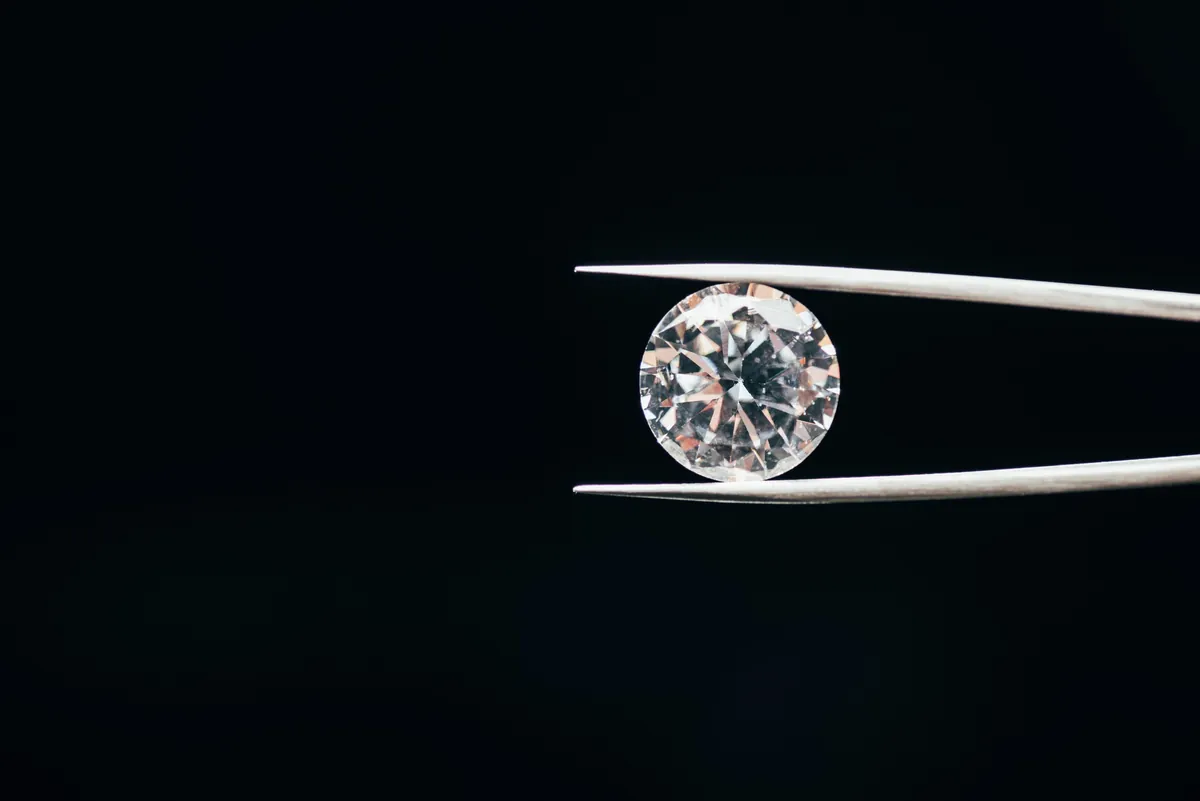
Cut is the one of the four most directly shaped by human skill. For round brilliants, the cut grade runs from Excellent through Very Good, Good and Fair to Poor. It describes how well the diamond returns light to the eye: its brightness, the white light reflected back; its , the flashes of spectral colour; and its , the sparkle you see when the stone or the viewer moves.
A modern round brilliant has 57 or 58 facets, depending on whether a tiny facet is cut at the point underneath. The angles and proportions of those facets decide how light travels through the stone. A diamond cut too deep or too shallow lets light escape through the bottom and looks darker, whatever its colour and clarity.
That is why many specialists treat cut as the C to protect first. A well cut diamond of modest colour and clarity can look livelier than a poorly cut stone with better grades on paper.
A full report also records details beyond the four headline grades: the exact measurements, the proportions, the quality of polish and symmetry, and any fluorescence. Many reports carry a number that can also be laser inscribed on the girdle, the thin outer edge of the stone, which links the diamond firmly to its paperwork.
Glossary
- Carat
- The unit of weight for gemstones: one carat equals 0.2 grams, divided into 100 points.
- Inclusion
- A tiny internal feature in a diamond, formed during its growth.
- Culet
- A small facet sometimes cut at the point underneath a round brilliant, making 58 facets instead of 57.
- Fire
- The flashes of spectral colour that a well cut diamond shows as light passes through it.
- Scintillation
- The sparkle and pattern of light and dark seen when a diamond or its viewer moves.
Questions readers ask
Is a 2 carat diamond twice the size of a 1 carat diamond?
No. Carat measures weight, and the diameter of a diamond grows with the cube root of its weight. A round brilliant of 1 carat measures roughly 6.4 to 6.5 mm across, while a 2 carat stone of similar proportions is only around a quarter wider, at about 8 mm. It weighs twice as much but does not look twice as large.
Which of the 4Cs matters most?
It depends on your priorities, but many specialists pay most attention to cut, because it decides how well the diamond returns light as brightness, fire and scintillation. Colour and clarity differences between neighbouring grades are often hard to see once a stone is set, while a poorly cut diamond can look dull whatever its other grades.
What does internally flawless mean?
Internally flawless, abbreviated IF, is the second highest clarity grade, just below flawless (FL). It means that no inclusions are visible inside the diamond at 10x magnification, although there may be very minor blemishes on its surface. Both grades are rare, and most diamonds used in jewellery fall further down the scale.