Bespoke, made to measure, ready to wear: a tailoring guide
Three ways to buy a suit, three very different processes. What bespoke really means, what happens at a fitting and the details that reveal quality.

Few words in menswear are used as loosely as . It turns up on labels, in shop windows and in advertising for things that have never been near a tailor’s cutting table. Yet in tailoring there are three distinct levels: bespoke, made to measure and ready to wear. Each describes a different process, and knowing the difference helps you judge what you are paying for and what to expect along the way.
Savile Row and the meaning of bespoke
The spiritual home of bespoke tailoring is Savile Row in London’s Mayfair, a street associated with gentlemen’s tailoring since the 19th century. Henry Poole & Co moved there in 1846, and the house is credited with creating an early dinner jacket for the Prince of Wales, later Edward VII, in 1865.
The word bespoke is often explained as cloth that had been “spoken for” by a particular customer. Whatever its origin, in tailoring it describes a garment that begins with a blank sheet of paper rather than an existing design. That single fact separates it from everything else on the rail. For many people the street’s name has become shorthand for the whole craft, and it remains a useful benchmark when you compare the three levels.
Bespoke: a pattern of your own
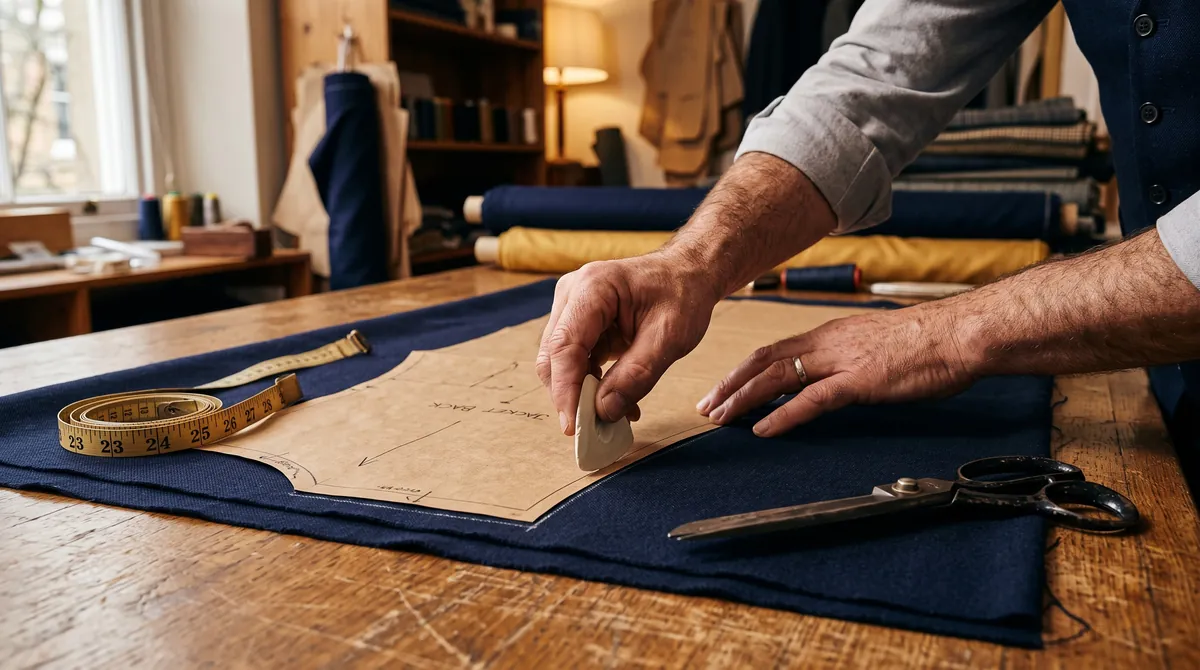
In true bespoke, the cutter takes your measurements, observes your posture and the way you stand, and drafts an individual paper pattern for you alone. The garment is then made largely by hand. A bespoke suit commonly takes many weeks and around 50 or more hours of work, spread across cutting, sewing, pressing and finishing.
Because the pattern is yours, it can account for things a standard size cannot: one shoulder lower than the other, a forward stance, a broad back. This is why bespoke can solve fitting problems that no amount of alteration will fix. It is also why the process needs patience, since the pattern is tested and corrected on your body rather than on a mannequin.
What happens at the fittings
A bespoke suit usually needs two or more fittings. The first is the , sometimes simply called the baste. At this stage the garment is only loosely tacked together in white thread, so the tailor can take it apart, adjust the pattern and recut where needed.
Do not be alarmed by how rough a basted jacket looks. Its job is to test balance, length and the run of the cloth over your body, not to impress. Stand naturally, wear the shoes and the kind of shirt you will wear with the finished suit, and carry what you usually carry in your pockets.
Later fittings refine the details: the line of the collar, the pitch of the sleeves, the length of the trousers. With each fitting the garment looks more finished and the adjustments become smaller. Speak up about anything that feels wrong, because this is the moment when it can still be changed easily.
Made to measure and ready to wear
Made to measure starts from an existing , a standard template, which is adjusted to your measurements. There is often one fitting. The result can fit very well, especially if your build is close to the block, but the pattern was not drawn for you, and the amount of handwork varies widely from maker to maker.
Made to measure is also a good way to learn what suits you. You usually choose the cloth, the lapels, the pockets and the lining, and you can see how small changes to a standard pattern alter the way a jacket hangs on you.
Ready to wear is produced in standard sizes and adjusted afterwards by alterations. A skilled alterations tailor can shorten sleeves, take in a waist or hem trousers, but the shoulders and the overall balance of a jacket are very hard to change. Buy for the shoulders first and alter the rest.
How to tell quality
Whichever level you choose, a few details reveal how carefully a garment was made. None is a guarantee on its own, but together they tell a story.
- A inside the jacket front, rather than a
- Working sleeve buttons that actually unbutton
- Hand-sewn buttonholes
- Stripes and checks matched at the seams
- A collar that sits close to the neck
The canvas matters most. A floating canvas is a layer of firm fabric stitched loosely inside the front of the jacket, which lets the cloth move and mould to your chest over time. A fused interlining is bonded to the cloth with adhesive. It is quicker to make but stiffer, and it can sometimes bubble.
Matched patterns are a quieter clue. Lining up stripes and checks across seams takes more cloth and more time, so it is a reliable sign that someone cared. The collar is the final test: if a gap opens between collar and shirt when you stand naturally, the balance of the jacket needs attention.
Buy for the shoulders first and alter the rest.
Choosing the right level for you
Bespoke makes sense when you want a garment for many years, when your figure does not suit standard sizes, or when you simply enjoy the process. Made to measure is a sensible middle ground if your build is fairly regular and you want a choice of cloth and details. Ready to wear, well chosen and well altered, can serve you perfectly for everyday use.
Whatever you buy, ask the maker plainly what you are getting. A good tailor will explain how the pattern is made, how many fittings to expect and how the jacket is constructed inside. If the answers are vague, that is an answer too.
Glossary
- Bespoke
- Tailoring in which an individual paper pattern is cut for one client and the garment is made largely by hand.
- Basted fitting
- The first bespoke fitting, with the garment loosely tacked together in white thread so it can be adjusted.
- Block pattern
- A standard template used in made to measure, adjusted to a client’s measurements rather than drafted from scratch.
- Floating canvas
- A layer of firm fabric stitched loosely inside a jacket front, allowing the cloth to move and shape itself to the body.
- Fused interlining
- An interlining bonded to the cloth with adhesive, quicker to produce but stiffer than a floating canvas.
Questions readers ask
How long does a bespoke suit take?
A bespoke suit commonly takes many weeks and around 50 or more hours of work. An individual paper pattern is cut for you, the garment is made largely by hand, and there are usually two or more fittings, starting with the basted fitting. The exact timing depends on the tailor and on how many adjustments are needed between fittings.
Is made to measure the same as bespoke?
No. Made to measure starts from an existing block pattern that is adjusted to your measurements, often with one fitting. Bespoke begins with an individual paper pattern drafted for you alone, is made largely by hand and usually involves two or more fittings. Made to measure can fit very well, but only bespoke is built from a pattern of your own.
What is the difference between a floating canvas and a fused interlining?
A floating canvas is a layer of firm fabric stitched loosely inside the jacket front, so the cloth can move and gradually mould to your chest. A fused interlining is bonded to the cloth with adhesive. It is quicker to make but stiffer, and it can sometimes bubble. A floating canvas is one of the clearest signs of careful construction.