Inside the goldsmith’s workshop
From sketch and wax model to casting, setting and polish: how a piece of fine jewellery is made, and what the numbers stamped on gold really mean.
A finished ring in a display case gives little away about how it was made. Behind it lies a sequence of careful steps, most of them done by hand at a wooden bench, and a small stamped number that tells you exactly how much gold you are wearing. Here is what happens inside a goldsmith’s workshop, from the first sketch to the final polish.
From sketch to model
Every piece starts as an idea on paper or on screen. Many goldsmiths still draw by hand, while others build a CAD model, a three-dimensional design made on a computer. Often it is both: a sketch to agree the idea with a client, then a model to test proportions.
A good design considers more than looks. It asks how the piece will be worn, how often, and what it must survive: a ring meets door handles and steering wheels every day, while a pair of earrings or a brooch leads a much quieter life.
For cast pieces the next step is a wax model. It can be carved by hand from a block of jeweller’s wax or produced from the CAD file. The wax is an exact stand-in for the finished piece, so this is the moment to check how a ring will sit on the finger or how a pendant will hang. Changes are easy in wax and costly in gold.
Casting or fabrication
is one of the oldest metalworking techniques there is. The wax model is encased in a heat-resistant, plaster-like material, then heated until the wax melts and burns away, leaving a hollow of exactly the right shape. Molten metal is poured or forced into that hollow, and once it has cooled the mould is broken away to reveal a rough casting. The piece is then cut from its sprue, the channel through which the metal flowed, and the real handwork begins.
The alternative is hand fabrication, building a piece directly from sheet and wire. The goldsmith saws, bends, forges and solders the metal into shape. Many pieces combine both methods, with a cast element joined to hand-made parts, and the choice depends on the design as much as on the workshop’s habits.
Life at the bench
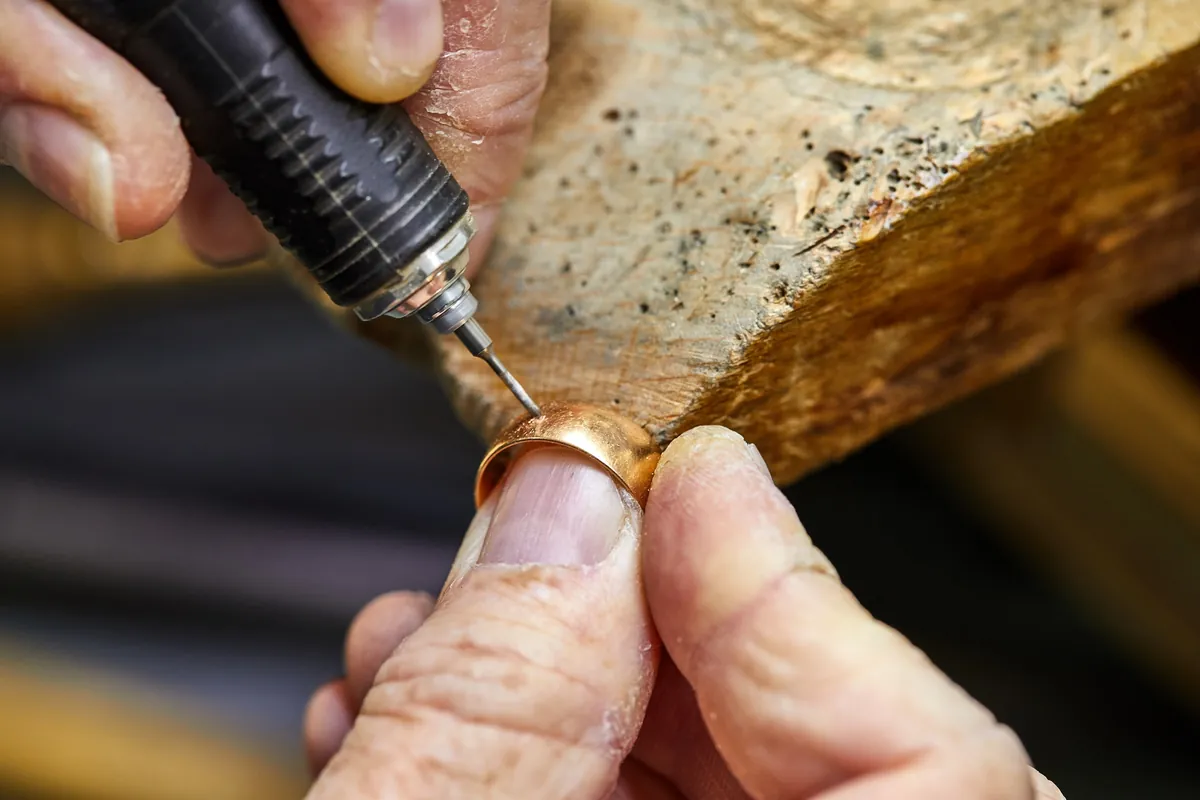
Whichever route is taken, most of the work happens at the jeweller’s bench. Its heart is the , or peg, a small wooden wedge that projects from the front edge. Pieces are held against it for most filing and sawing, and over the years its surface becomes notched and worn into the shape of its owner’s habits.
Beneath the pin hangs a leather skin. It catches the fine dust and filings of precious metal, known as , which are collected and sent to be refined. In a goldsmith’s workshop even the dust is valuable.
In a goldsmith’s workshop even the dust is valuable.
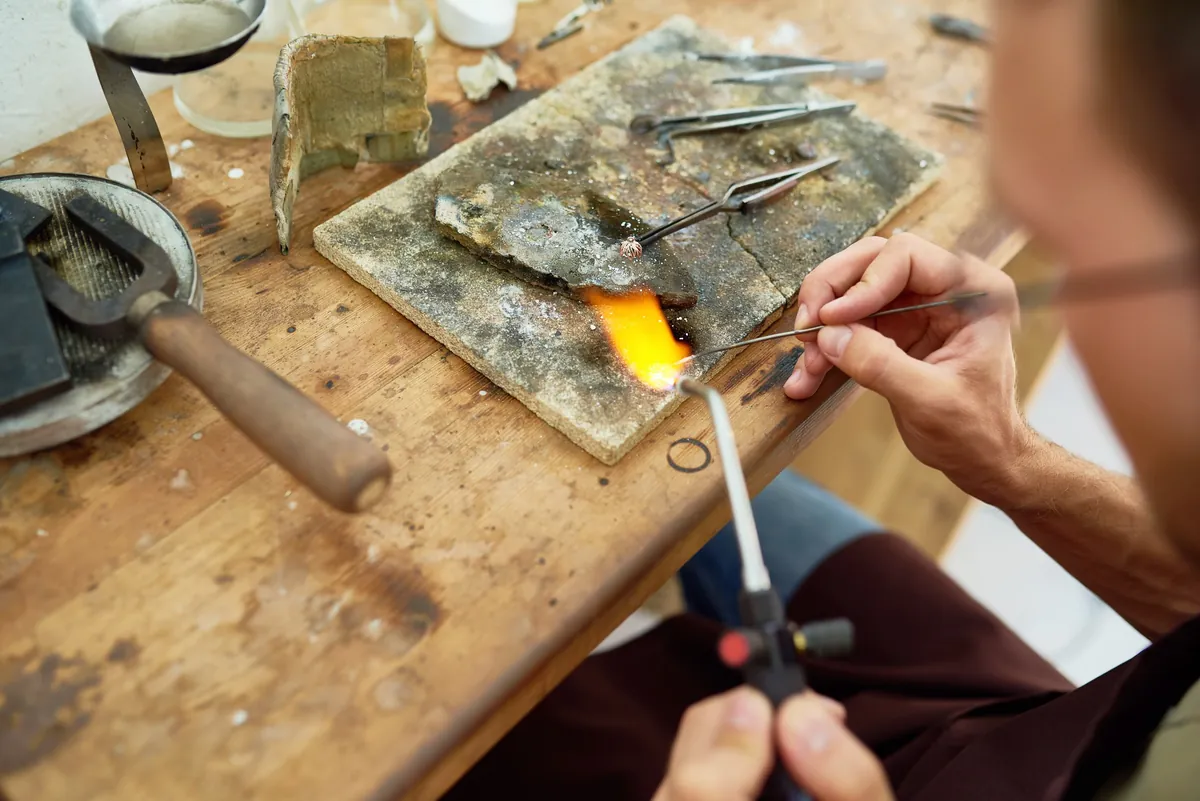
Filing removes the rough surface left by casting and refines the shape. Soldering joins parts together using an alloy that melts at a lower temperature than the metal being joined. It takes judgement and a steady hand: too little heat and the joint fails, too much and the piece itself can begin to melt.
Setting the stones
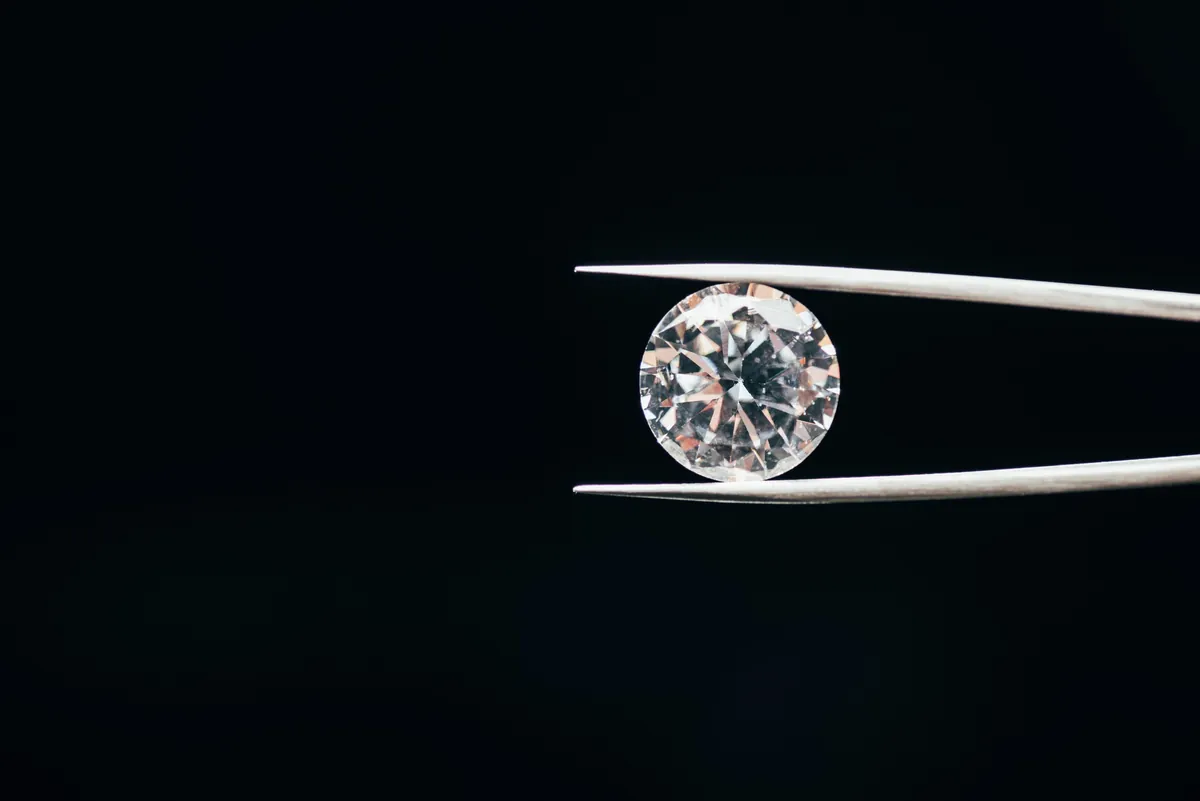
Stone setting is a craft of its own, and in larger workshops it is often done by a specialist setter. The aim is always the same: hold the stone securely while showing it to best advantage. The main settings do this in different ways.
- Prong (claw): small metal claws grip the stone and let in plenty of light.
- Bezel (rub-over): a collar of metal is pressed over the edge of the stone, protecting it well.
- Pavé: many small stones set close together, so the surface looks paved.
- Channel: a row of stones held between two walls of metal.
- Invisible: stones fitted edge to edge with no metal visible from the front.
The order of work matters. Heat from soldering could damage many gemstones, so most soldering is finished before any stones go in. Once the stones are set, engraving may follow, adding pattern, lettering or texture by hand.
Polish, plating and colour
Polishing comes near the end, working through progressively finer compounds until the surface reflects cleanly. Some pieces are then plated. White gold, which is gold alloyed with white metals such as palladium or silver, is often rhodium plated to give it a brighter, whiter surface.
Rose gold, by contrast, owes its warm colour to a higher share of copper. Plating wears with time, which is why a white gold ring can slowly look warmer after years of wear. Replating is a routine job for a workshop, not a sign that anything is wrong.
A skilled polisher also knows when to stop. Too much polishing softens crisp edges and fine engraving, so the final finish is a matter of judgement as much as effort.
What gold purity means
Gold purity is measured in karats, out of 24. Pure gold, 24 karat, is about 99.9 per cent gold, and it is also soft, so jewellery is usually made from alloys that add strength and change the colour. An 18 karat alloy is 75 per cent gold, 22 karat is 91.6 per cent, 14 karat 58.5 per cent and 9 karat 37.5 per cent.
On the piece itself you will often find a millesimal fineness number instead, giving parts per thousand. So 750 means 18 karat, 585 means 14 karat and 375 means 9 karat, while 916 and 999 stand for 22 karat and pure gold. A higher number means more gold and a softer metal; a lower number means a harder wearing alloy. Neither is better in itself, only better suited to a particular piece. Colour belongs to the same story: the metals added to gold do more than strengthen it, with copper warming it towards rose and palladium or silver drawing it towards white.
Glossary
- Lost wax casting
- A method in which a wax model is encased, melted out and replaced with molten metal poured into the hollow it leaves.
- Bench pin
- The small wooden wedge, or peg, on the front of a jeweller’s bench against which pieces are filed and sawn.
- Lemel
- Fine dust and filings of precious metal collected at the bench and sent for refining.
- Bezel setting
- Also called rub-over: a collar of metal pressed around the edge of a stone to hold it.
- Rhodium plating
- A thin coating of rhodium often applied to white gold to give it a brighter, whiter surface.
Questions readers ask
Why is white gold often rhodium plated?
White gold is gold alloyed with white metals such as palladium or silver. Rhodium plating gives it a brighter, whiter surface. The plating wears with time, so a white gold ring can gradually look slightly warmer in colour. A goldsmith can replate it as a routine job, which restores the original finish without any harm to the piece.
What does the number 750 on jewellery mean?
It is a millesimal fineness mark: 750 parts per thousand are gold, which is the same as 18 karat or 75 per cent. Other common numbers are 375 for 9 karat, 585 for 14 karat, 916 for 22 karat and 999 for pure gold. The number describes the purity of the metal, not the quality of the craftsmanship.
Is 24 karat gold the best choice for jewellery?
Not necessarily. Pure gold, 24 karat, is about 99.9 per cent gold, but it is soft. Most jewellery is made from alloys that add strength and change the colour. Higher karats contain more gold, while lower karats such as 9 or 14 are harder wearing. The right choice depends on the piece and on how often you will wear it.