Royal wedding dresses that changed fashion
From Queen Victoria’s white satin to Meghan’s Commonwealth veil: five royal and near royal dresses, and the ideas each one gave to brides everywhere.
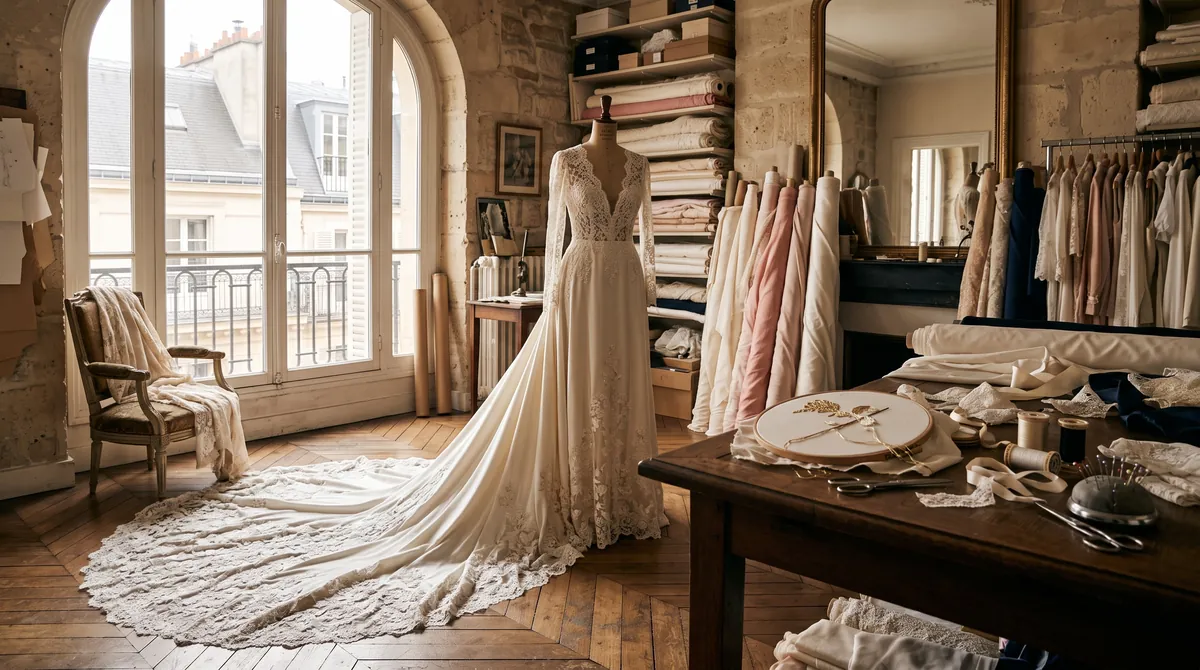

Most wedding dresses are seen by a few hundred guests. A royal wedding dress is seen by the world, photographed from every angle and studied by dressmakers for years afterwards. That is why a handful of them have shaped what brides wear far beyond palace walls. Here are five royal and near royal dresses, from 1840 to 2018, and the ideas each one left behind.
1840: Queen Victoria chooses white
When Queen Victoria married Prince Albert in 1840, she wore a dress of white satin trimmed with . The choice sounds obvious today, but white was not yet the fixed custom it later became. Many brides simply wore their best dress, whatever its colour.
Victoria’s wedding was widely reported, and she is credited with popularising the white wedding dress. Her lace mattered too. Honiton lace is a handmade English lace, and by choosing it a young queen showed how a royal bride could champion a domestic craft simply by wearing it.
The lasting lesson is that the most influential choices are often the simplest. Victoria did not invent a new silhouette or a new fabric. She changed a colour, and that change has held for more than a century and a half.
1956: Grace Kelly brings Hollywood to Monaco
When the American actress Grace Kelly married Prince Rainier III of Monaco in 1956, her dress came from the film world rather than from a Paris couture house. It was designed by Helen Rose of MGM, the Hollywood studio to which Kelly was under contract.
The dress combined with seed pearls. Where Victoria had made her statement with colour, Kelly’s dress made one with texture and restraint. Lace was not a trimming here but the centre of the design, and the effect was modest, polished and quietly luxurious.
A costume designer brings a particular skill to a wedding dress. Film costume is made to be read by a camera, and Kelly’s wedding was filmed and watched far beyond Monaco. The result looked as composed on screen as it did in person, a quality any bride who will be photographed all day can appreciate.
1981: Diana and the 25 foot train
Lady Diana Spencer married Prince Charles in 1981 at St Paul’s Cathedral in a dress by the London designers David and Elizabeth Emanuel. It was made of , and its measured 25 feet, about 7.6 metres. The sight of that train following her up the aisle became one of the most familiar wedding images of the 20th century.
The dress captured the taste of its moment: volume, romance and drama. Full sleeves, layered skirts and long trains were much in demand among brides in the years that followed. It is a reminder that a royal dress can do more than follow a trend; sometimes it defines one.
Silk taffeta was a telling choice. It is crisp and holds its shape, which makes it ideal for volume, but it also creases easily. If you are drawn to a similar fabric, ask your dressmaker how it will behave after a car journey and a long ceremony.
2011: Catherine and the return of lace
Thirty years later, Catherine Middleton married Prince William at Westminster Abbey in a dress by Sarah Burton for Alexander McQueen. Its lace was made by the Royal School of Needlework, which is dedicated to the art of hand embroidery. On her head she wore the Cartier Halo Tiara, lent by Queen Elizabeth II.
After the volume of the 1980s, the dress felt fitted and controlled, with long lace sleeves and lace used for detail rather than bulk. It is easy to draw a line from Grace Kelly’s lace to this one, and lace sleeves became a popular bridal choice in the years that followed.
The borrowed tiara mattered as much as the dress. It linked the bride to the family she was joining and showed that a royal wedding look is often built from heirlooms as much as from new couture. Something lent, rather than bought, can carry the most meaning.
2018: Meghan and the Commonwealth veil
Meghan Markle married Prince Harry in 2018 at St George’s Chapel, Windsor, in a dress by Clare Waight Keller for Givenchy. The dress itself was strikingly simple, relying on cut and fabric rather than ornament. The story was in the veil, which was embroidered with the flora of the 53 Commonwealth countries.
This was a different kind of influence. Instead of a silhouette or a fabric, the dress offered an idea: that symbolism can be stitched into a garment, visible up close and invisible from a distance. It is an approach any bride can borrow, whether with a meaningful flower, a date or initials worked into a hem or veil.
What the five dresses have in common
Seen side by side, the five dresses share a pattern. Each made one clear choice: a colour, a fabric, a length, a technique or a symbol. None tried to do everything at once, which is why each can still be described in a single sentence.
Each made one clear choice: a colour, a fabric, a length, a technique or a symbol.
Each also relied on specialist hands, from lacemakers and embroiderers to designers trained in film costume and couture. A royal wedding dress is, among other things, a showcase for craft. The most memorable ones make that craft visible, and that may be their most useful lesson for anyone planning a wedding of their own.
Glossary
- Honiton lace
- A handmade English bobbin lace named after the town of Honiton in Devon.
- Rose point lace
- A fine needle lace with raised, flower-like motifs.
- Silk taffeta
- A crisp, smooth silk fabric that holds its shape well, which suits full skirts and volume.
- Appliqué
- A technique in which motifs are cut from one material and stitched onto another, such as lace onto silk.
- Train
- The part of a dress, or a separate panel, that extends behind the wearer and trails along the floor.
Questions readers ask
Who made the white wedding dress popular?
Queen Victoria is credited with popularising the white wedding dress. When she married Prince Albert in 1840 she wore white satin trimmed with Honiton lace, at a time when white was not yet the fixed custom and many brides simply wore their best dress. Her wedding was widely reported, and white gradually became the expected choice for brides.
Which tiara did Catherine wear on her wedding day?
Catherine Middleton wore the Cartier Halo Tiara when she married Prince William at Westminster Abbey in 2011. It was lent to her by Queen Elizabeth II. Royal tiaras are often lent by the sovereign rather than given outright, which allows a bride to wear a piece of family history on the day itself.
How long was Diana’s wedding train?
The train of the silk taffeta dress that David and Elizabeth Emanuel designed for Lady Diana Spencer in 1981 measured 25 feet, which is about 7.6 metres. It became one of the most familiar images of her wedding at St Paul’s Cathedral, and full, romantic silhouettes with long trains were much in demand among brides in the years that followed.