At the watchmaker’s bench: what a service really involves
A mechanical watch needs a full service every few years. Here is what the watchmaker actually does, how a movement works and how to protect it in between.
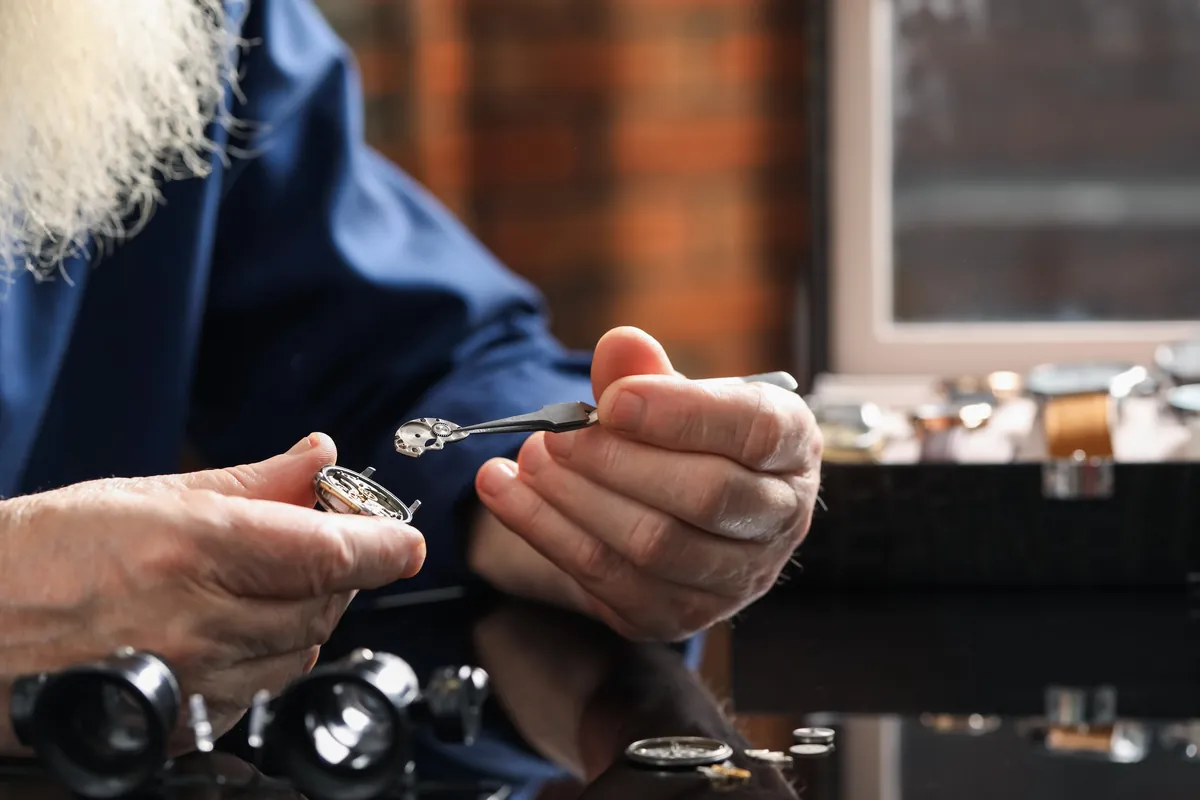
A mechanical watch can run for decades, but not entirely on its own. Every few years it needs a visit to the watchmaker’s bench, where it is taken apart, cleaned, oiled and rebuilt. Knowing what happens there helps you understand what you are paying for, ask the right questions and look after your watch in the years between.
The parts that keep time
A mechanical movement has four essential systems. Energy is stored in the , coiled inside a small drum called the barrel. As the spring unwinds, its force passes through the gear train, a series of wheels that carries the power onwards and also drives the hands. In an automatic watch, a rotor winds the mainspring as your wrist moves, but the principle is the same.
The , made up of the escape wheel and the pallet fork, releases that energy in tiny, regular steps. Each step gives a small push to the balance wheel, which swings back and forth under the control of the . Together, the balance and hairspring are the regulating organ, the part that actually measures time.
Their speed is described in vibrations per hour. A common rate is 28,800 vibrations per hour, also expressed as 4 Hz. Every one of those vibrations depends on clean, correctly lubricated parts moving with very little friction, and protecting that is the whole purpose of a service.
What a full service involves
A full service is far more than a quick check or a polish. Although every workshop has its own routine, it usually follows the same sequence.
- Dismantling the movement completely
- Cleaning every part
- Replacing worn parts and gaskets
- Lubricating with several different oils
- Reassembly
- Regulation, so the watch keeps good time
- Water resistance testing
Dismantling and cleaning take patience. A movement is made of a great many small parts, some barely visible to the naked eye, and each one is inspected as it comes out. Worn or damaged components are replaced, so that the watch goes back together in better health than it arrived.
Lubrication is the most delicate step. A watch uses several different oils, each matched to a particular point in the movement, from the fast moving parts of the escapement to the slower, heavily loaded parts near the mainspring. Tiny amounts are applied in exactly the right places, because too much oil can do as much harm as too little.
Gaskets deserve attention too. These small seals around the crown, the case back and the crystal age with time, and a watch that was water resistant when new will not stay that way unless they are checked and replaced.
When you collect the watch, ask for a written note of the work done and the parts replaced, and keep it with the watch. It becomes part of the watch’s history and will be useful to you, or to a future owner, for years to come.
Timing and testing
Once the movement is reassembled, the watch goes onto a timing machine. It picks up the sound of the escapement and shows whether the watch is running fast or slow and how evenly it beats. It also shows the amplitude, how far the balance swings, which tells the watchmaker whether enough power is reaching it. The watchmaker checks it in several positions, dial up, dial down and with the crown pointing in different directions, because gravity affects the balance differently in each.
Watches sold as chronometers in Switzerland have been certified by the , the official Swiss chronometer testing body. A service cannot turn an ordinary watch into a chronometer, but a careful watchmaker will regulate any movement as closely as its design allows.
The last check is the water resistance test. It matters for any watch you wear near water, and it is worth asking for even on an older piece, as long as the watchmaker considers the case suitable for testing.
How often, and why
Many manufacturers recommend a service roughly every five to ten years, depending on the watch and how it is used. A watch worn every day, through sport and travel, will usually need attention sooner than one kept for occasional evenings.
A watch that still runs well is not necessarily healthy. Oils age and dry out over time, and as they do, metal parts can begin to wear against one another. Servicing on schedule is usually kinder to the movement than waiting for it to stop.
Before any work begins, ask for an estimate and what it covers. A full service and a simple regulation are very different jobs, and a clear description of the work avoids surprises when you collect the watch.
A watch that still runs well is not necessarily healthy.
Looking after your watch between services
Most everyday trouble comes from three sources. The first is magnetism, from phones, speakers and even magnetic bag clasps. It can make a watch run erratically, often noticeably fast, and a watchmaker can usually demagnetise it quickly.
The second is shock, from a fall or a hard knock during sport. The third is water entering through a crown that has not been screwed down or pushed fully home. Check the crown every time you set or wind the watch, and make it a habit before you wash your hands or swim.
Beyond that, wind a manual watch at roughly the same time each day, keep it away from strong magnets and have it checked if its timekeeping changes suddenly. Small habits like these are the simplest way to keep a mechanical watch healthy between visits to the bench.
Glossary
- Mainspring
- The coiled spring inside the barrel that stores the energy driving a mechanical watch.
- Escapement
- The escape wheel and pallet fork, which release the mainspring’s energy in small, regular steps.
- Hairspring
- The fine spiral spring attached to the balance wheel that controls its oscillations.
- COSC
- Contrôle Officiel Suisse des Chronomètres, the official Swiss body that tests and certifies chronometers.
- Gasket
- A small seal at the crown, case back or crystal that helps keep water and dust out.
Questions readers ask
How do I know if my watch is magnetised?
A magnetised watch often starts to run erratically, typically gaining time noticeably. Common sources are phones, speakers and magnetic bag clasps. A watchmaker can test for magnetism and demagnetise the watch quickly, usually without taking the movement apart. If your watch suddenly gains several minutes a day, magnetism is one of the first things worth checking.
Why should I service a watch that still runs well?
Because the oils inside a movement age and dry out over time. As they do, metal parts begin to wear against each other, even while the watch keeps reasonable time. A full service cleans every part, replaces worn parts and gaskets, and applies fresh oil. Many manufacturers recommend this roughly every five to ten years, depending on the watch and its use.
Is my old watch still water resistant?
Not necessarily. Water resistance depends on gaskets at the crown, case back and crystal, and these seals age with time. A watch that was water resistant when new may no longer be. A full service usually includes replacing gaskets and testing water resistance, and you should always make sure the crown is screwed down or pushed fully home.