Starting an art collection: editions, prints and originals
Originals and editions, primary and secondary market: a grounded guide to buying your first works, keeping the right papers and living with art.


Many people never start an art collection because they assume it begins with a famous name and a large budget. In reality a collection can begin with a single work you simply cannot stop looking at. The rest is knowledge: what you are buying, where to buy it and how to look after it once it is on your wall.
Originals and editions
The first distinction is between originals and editions. Original works, such as paintings, drawings and unique sculptures, are one of a kind. Editions, such as prints, photographs and cast sculptures, are produced in numbered series.
Neither is better by definition. An original gives you the only example of a work. An lets you own a work that exists in several examples, often by an artist whose unique pieces would be beyond your budget. Many thoughtful collections combine both, and many artists work seriously in both forms.
What matters is that you know which one you are buying, and that the price, the paperwork and the description all agree. A seller should be able to tell you clearly whether a work is unique or one of a series, and how large that series is.
Reading edition numbers and proofs
Edition numbers are usually written in pencil in the lower margin of a print. A number such as 12/50 means the twelfth impression of an edition of 50. The second figure tells you how many examples exist in the edition; a smaller edition generally means a scarcer work.
Artists also make proofs. Artist’s proofs are marked AP and are usually a small additional number, outside the main edition. They are counted separately, so an edition of 50 with a handful of proofs contains slightly more than 50 examples in total.
Look for consistency. The edition size printed on a certificate should match the number written on the work, and a gallery or publisher should be able to confirm both.
Prints: original or reproduction
Printmaking has a long history and several distinct techniques. Etching uses lines bitten into a metal plate with acid. Lithography prints from a drawing made with greasy materials on stone or a plate. Screenprint, also called silkscreen, pushes ink through a fine mesh. Woodcut carves the image into a block of wood and prints from the raised surface.
The key term is . An original print is made by or under the supervision of the artist, as an artwork in its own right. A reproduction, by contrast, is a copy of an existing work, often a painting, made by mechanical or digital means. Both can be attractive, but only one is an original work by the artist.
Many artists work with specialist printers or print studios, and the paper, the inking and the pressure all shape the result. That is why two impressions from the same edition can differ slightly, and why condition matters for prints as much as it does for paintings.
In reality a collection can begin with a single work you simply cannot stop looking at.
Where to buy: primary and secondary market
The means buying directly from the artist or from the gallery that represents them. It is where works are sold for the first time, and buying there supports the artist directly. Galleries can also tell you about an artist’s exhibitions and the context of a particular work.
The secondary market means resale through dealers or auctions. It offers works that have already had at least one owner, including earlier pieces that are no longer available from the studio. Here, the history of the work and its condition become part of what you are buying.
Whichever market you use, take your time. Visit degree shows, galleries, art fairs and auction viewings, and look at a great deal of art before you buy. Your eye improves with every work you study, and so does your sense of what you really want to live with.
Ask questions freely. A good gallery or dealer will explain the work, the edition, the condition and the price without pressure, and will put the important details in writing on the invoice.
Paperwork that protects your collection
Every work you buy should arrive with its paperwork. Keep a certificate of authenticity where one is issued, the invoice, and any records of exhibitions and publications together with the work. These documents form its provenance and will matter when the work is insured, lent or one day sold.
Note the details on your invoice as well: title, date, medium, dimensions and, for editions, the number. Photograph the front and back of each work, including any labels or inscriptions. A simple record kept from the start saves a great deal of searching later. Store digital copies of everything separately from the originals.
Living with art: conservation basics
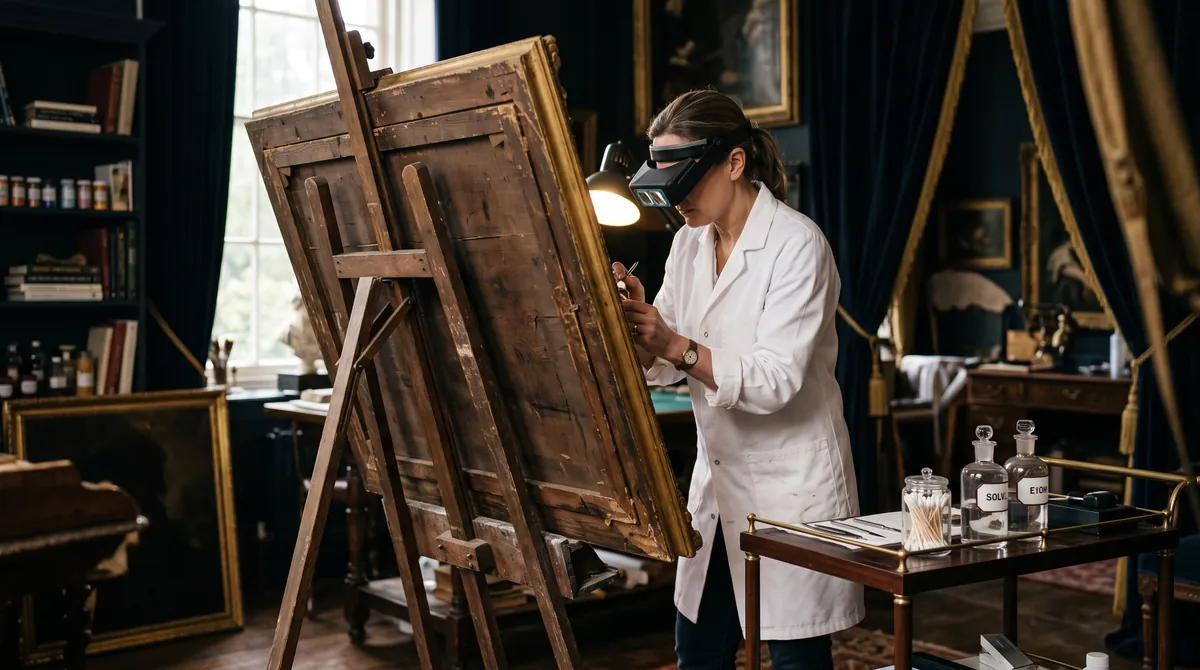
Living with art also means protecting it. Avoid direct sunlight, which fades pigments and paper. Use UV filtering glazing and acid-free mounts for works on paper, and keep humidity stable, since changes in moisture can make paper cockle and cause other materials to move.
Hanging matters too. Use fixings suited to the weight of each work, hang heavier pieces from two points rather than one, and handle frames by their sides rather than by the top edge.
Start with what moves you, learn as you go and keep good records. A collection built that way has meaning from the first work onwards, and it tells the story of your own taste as it grows.
Glossary
- Edition
- A numbered series of the same work, such as prints, photographs or cast sculptures.
- Artist’s proof
- An impression marked AP, made in a small number outside the main numbered edition.
- Original print
- A print made by or under the supervision of the artist, as an artwork in its own right.
- Primary market
- Buying a work for the first time, directly from the artist or the gallery that represents them.
- Acid-free mount
- A mount board free of acids that would otherwise discolour and weaken paper over time.
Questions readers ask
Is a signed print the same as an original print?
Not necessarily. An original print is made by or under the supervision of the artist, using a technique such as etching, lithography, screenprint or woodcut. A signature on a reproduction of a painting does not make it an original print. Check the technique, the edition number and the documentation, and ask the seller to explain exactly how the work was made.
How should I protect works on paper at home?
Keep them out of direct sunlight, which fades pigments and paper over time. Frame them with UV filtering glazing and acid-free mounts, and hang them where humidity stays stable, away from bathrooms, kitchens and radiators. Check the back of the frame now and then, and if a work shows stains or buckling, consult a qualified paper conservator.