Salvator Mundi and the price of attribution
From £45 in 1958 to about 450.3 million dollars in 2017: what the story of Salvator Mundi teaches about attribution, restoration and value.

In 1958 a painting of Christ sold at a London auction for £45. In November 2017 the same picture sold in New York for about 450.3 million US dollars. What changed between the two sales was, above all, the name attached to it. That change, from a Leonardo da Vinci to Leonardo himself, is the real subject of this story.
From £45 to a world record
Salvator Mundi shows Christ as Saviour of the World, raising one hand in blessing and holding a crystal orb in the other. When it was sold at a London auction in 1958 for £45, it was attributed to a follower of Leonardo, not to the master himself. Fewer than sixty years separate that sale from the record of 2017, and in that time the picture moved from a modest lot in a London saleroom to the centre of international attention.
The painting was rediscovered in 2005 and extensively restored. It was then shown as a work by Leonardo in the National Gallery’s Leonardo exhibition in London in 2011 to 2012, a public endorsement that placed it among the master’s accepted works in the eyes of many visitors.
On 15 November 2017 it sold at Christie’s in New York for about 450.3 million US dollars including fees, the highest price ever paid for a painting at auction. The figure made headlines around the world, and it turned a question of scholarship into a question that everyone seemed to have an opinion about.
What attribution means
is the judgement of who made a work. For paintings it rarely rests on a signature. Specialists compare style, technique, materials and documents, and they weigh what is known about the artist’s and followers.
Scientific study can help. Technical examination of pigments, supports and underdrawing may show whether the materials fit an artist’s time and methods, but it rarely settles authorship on its own. In the end, attribution remains a matter of expert judgement.
Auction catalogues express that judgement through a precise hierarchy of terms. When a house prints the full name of the artist, it means the house believes the work is by that artist. Other phrases signal decreasing certainty.
- Full name of the artist: in the house’s opinion, a work by the artist.
- “Attributed to”: probably by the artist, but with some doubt.
- “Studio of”: made in the artist’s workshop, possibly under the artist’s supervision.
- “Circle of”: by an unidentified hand of the period, close to the artist’s style.
- “Follower of”: in the artist’s style, not necessarily by a pupil.
- “Manner of”: in the artist’s style but of a later date.
Each step down that ladder can change the value of a picture dramatically. The same painting, catalogued under the full name of a great artist or as the work of a follower, can be valued in entirely different worlds.
The same painting, catalogued under the full name of a great artist or as the work of a follower, can be valued in entirely different worlds.
Restoration and condition
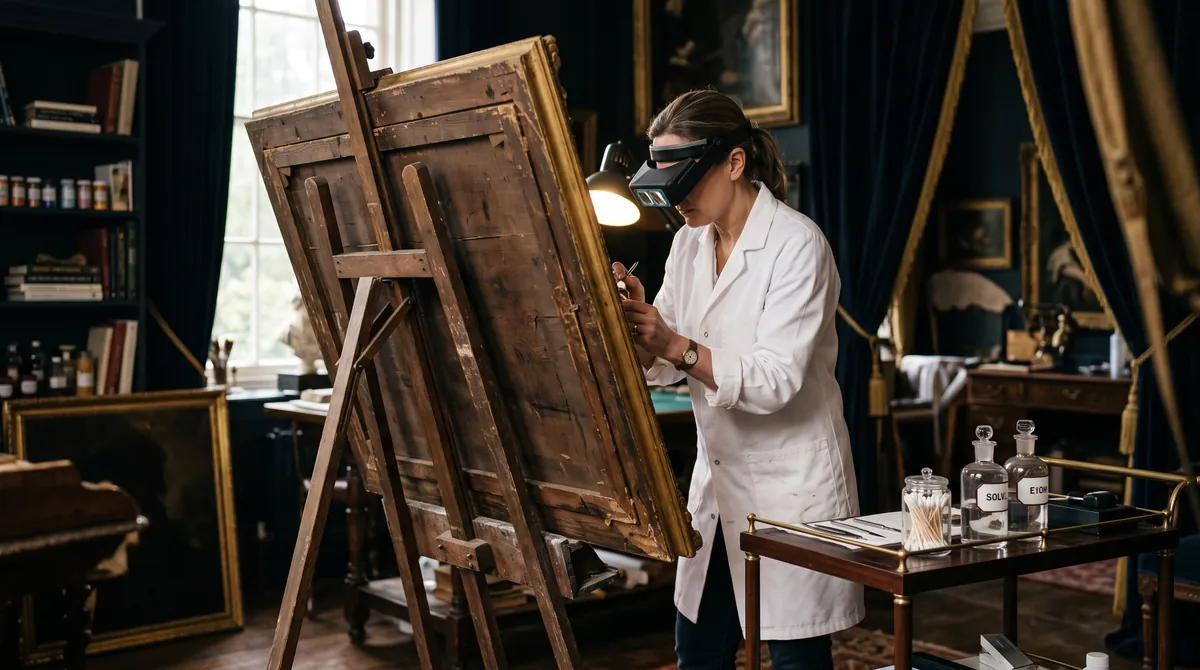
Restoration and condition are key questions for any old master painting. Centuries of cleaning, retouching and varnishing can obscure the original surface or alter it. A restorer removes later layers, stabilises the paint and fills losses, and every decision affects what viewers and scholars see.
Salvator Mundi was extensively restored after its rediscovery. That work made the painting legible again, but it also became part of the debate. When a picture has needed significant treatment, specialists ask how much of what we see today is original and how much belongs to later hands.
Good practice today favours treatments that can be reversed and records each step in photographs and reports. Those records then become part of the painting’s own history, available to later scholars who want to judge the work for themselves.
A debate that continues
Scholarly opinion is divided. Some scholars accept the attribution to Leonardo; others believe the painting is largely by his workshop. The debate continues, and both positions are argued by serious specialists.
Disagreement of this kind is normal in the world of old masters. Only a small number of paintings by Leonardo survive, and in the workshops of his time assistants often contributed to pictures that left the studio. Separating the master’s hand from that of his pupils is one of the hardest tasks in art history.
For a buyer, the strength of an attribution depends on the depth of scholarship behind it, the documents that support it and the willingness of specialists to stand by it. A single confident opinion is worth less than a broad consensus built over years.
History of ownership: the third pillar
Alongside attribution and condition, the history of ownership is the third pillar of value for an old master painting. A clear provenance can support an attribution by connecting a picture to known collections and earlier records. Gaps, by contrast, leave room for doubt.
The story of Salvator Mundi shows how these three pillars lean on each other. Restoration changed what could be seen, scholarship changed what the picture was called, and the public exhibition and the auction placed it firmly in the record. Each step added weight to the next.
Lessons for collectors at any level
Few of us will ever bid on a Leonardo. But the same questions shape the value of a modest old master drawing or a nineteenth century portrait bought at a regional sale.
Ask for a condition report, look closely at the history of ownership and, for important works, take independent advice before you bid. Look closely at how the house describes earlier restoration, and ask for additional photographs if the work matters to you.Salvator Mundi is an extreme case, but its lesson is an ordinary one. A painting’s price rests not only on what it shows but on what experts are willing to say about who made it.
Glossary
- Attribution
- The judgement, based on style, technique, materials and documents, of which artist made a work.
- Old master
- A leading European painter working before about 1800, or a painting by such an artist.
- Workshop
- An artist’s studio, where assistants and pupils helped to produce works under the master’s direction.
- Follower of
- A catalogue term for a work in an artist’s style by another painter, not necessarily a pupil.
Questions readers ask
Is Salvator Mundi definitely by Leonardo da Vinci?
Opinion is divided. Some scholars accept the attribution to Leonardo, while others believe the painting is largely the work of his workshop. It was sold in 2017 as a work by Leonardo and had been shown as his in the National Gallery’s exhibition in London in 2011 to 2012, but the scholarly debate about how much of it is by his own hand continues.
Why does attribution matter so much for price?
Collectors pay for authorship as well as for the image. A work securely catalogued under a great artist’s full name sits in a very different market from one described as “circle of” or “follower of”. The wording reflects how confident specialists are, and that confidence, supported by scholarship, condition and provenance, is what bidders are ultimately paying for.